

Since ancient times, humans have been deeply fascinated by the circle. Long before written language existed, circular shapes appeared in cave art, sacred architecture, ritual objects, and ancient symbols across cultures. Something about the circle naturally captured the human imagination and intuition.
Many philosophers and spiritual traditions have described the circle as the most perfect shape. Unlike other forms, it has no corners, no beginning, and no end. It flows endlessly into itself, representing continuity, balance, and wholeness. Because of this unique quality, the circle has long been seen as a powerful symbol of eternity and unity.
In this article, let’s explore several ancient circular symbols from different cultures and uncover the powerful meanings and spiritual ideas they represent.
1. Yin and Yang
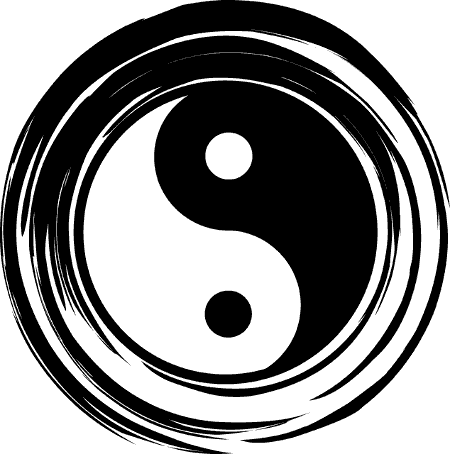
Yin Yang is a popular Taoist symbol that represents how the universe works. At the core of the universe is the interplay of duality – two opposing yet complementary forces. These forces are represented by the black (Yin / Feminine) and white (Yang / Masculine) halves of the symbol.
As you will notice, the black contains a white dot and the white contains a black dot, suggesting that opposites, though appearing separate, are not truly separate, they contain each other within.
The symbol is also visualized as a moving circle, representing the cyclic nature of existence and the idea that different energies become dominant at different times as the cycle unfolds. For instance, in a typical day and night cycle we have the morning, noon, evening, and night, showing the constant shift of energies from Yang (morning) to Yin (night) and then back again from Yin to Yang.
To know more about this symbol and its deeper symbolism, read this article on the Yin Yang.
2. Enso
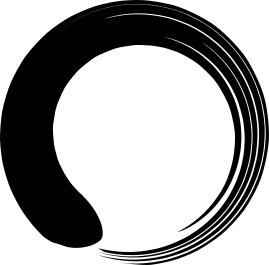
The Enso is a Zen symbol drawn with a single brushstroke, forming a circle. The circle is usually imperfect, symbolizing the acceptance of imperfection and things as they are. The empty space inside the circle represents openness and possibility, while the circular form itself symbolizes wholeness and the natural flow of life.
Similar to the Yin Yang, the thicker stroke at the beginning and the lighter stroke toward the end suggest the interplay of two opposing energies that arise from the same source (same ink).
3. Ouroboros
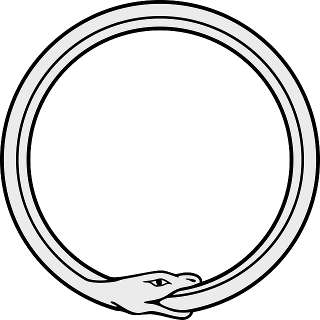
Traditionally an ancient Egyptian and Greek symbol, the Ouroboros depicts a snake eating its own tail, forming a perfect circle. The symbol illustrates the very nature of existence. The snake both creates and consumes itself, suggesting that life continuously feeds on life in an endless cycle.
In this way, the Ouroboros represents existence as an eternal process of renewal – a constant transition between living and dying.
4. Vesica Piscis

The Vesica Piscis is a sacred geometry symbol formed by two overlapping circles. The circles intersect in such a way that the boundary of each circle passes through the center of the other, creating an almond-shaped space in the middle. This is said to represent the Cosmic Womb that is formed by the merging of spiritual and material worlds.
It is interesting to note that the shape of the Vesica Piscis bears a striking resemblance to the form of the first embryonic division that occurs after fertilization (as illustrated in the image below). This division is just the first step in the process of forming a complete human being.

Thus the Vesica Piscis is a potent symbol of creation.
When the circles are lying on top of each other (as shown in the image below), the horizontal lens is said to represent the cosmic eye or the Third Eye chakra.

The Vesica Piscis also contains within it many important sacred geometry symbols including the Equilateral Triangle, Rhombus, Hexagon, Six-Pointed Star, Triquetra, Seed of Life, Lotus of Life, Torus, and Flower of Life, to name a few.
5. Triquetra (Trinity Knot)
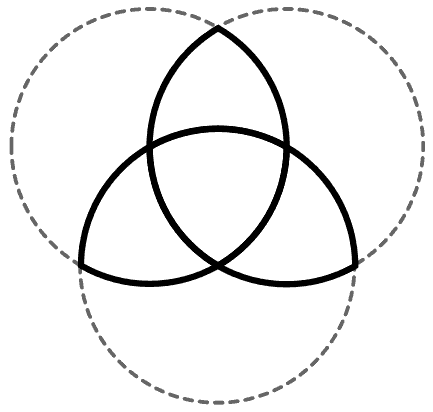
The Triquetra (meaning 3 cornered) is an ancient Norse symbol that looks like a triangle made of interlaced arcs. Not many are aware of this but the Triquetra is in reality a circular symbol as it has been derived by adding an additional circle to the Vesica Piscis.

The Triquetra represents creation, the interconnectedness of life, and natural life cycles. It also represents the Trinity and all important aspects of life that appear in sets of three which include – Mind, Body, and Spirit, Creation, Preservation and Destruction, and so on. The central dot in the Triquetra represents oneness or source energy.
6. Seed of Life

The Seed of Life is another sacred circular symbol that has been derived from the Vesica Piscis. The Seed of Life is formed when you add 5 additional circles to the Vesica Piscis (or 4 additional circles to the Triquetra) as shown in the image below.

The Seed of Life is an ancient symbol that is believed to contain the blueprint for the universe.
It has six intersecting circles along with one circle in the center. These seven circles are said to represent the Biblical seven days of creation. Also, each circle is interconnected, symbolizing the interconnectedness of all things and the unity of the universe.
The Seed of Life is the base pattern that gives rise to the Flower of Life pattern and other patterns like the Fruit of Life, Metatron’s Cube, and the Platonic Solids (that are considered to be the building blocks of the universe).
7. Lotus of Life

When you superimpose two Seed of Life Patterns and rotate one pattern by 30 degrees, you get the beautiful Lotus of Life Pattern. This pattern represents purity, strength, balance, unity, and spiritual enlightenment.
8. Torus

The Torus is another powerful circular symbol that can be derived from the Seed of Life symbol. When you stack eight Seeds of Life on top of each other and rotate each by a small degree, they come together to create the Torus energy field, as shown in the video below:
9. Flower of Life

When you add 12 additional circles to the Seed of Life, you get the Flower of Life pattern.
This symbol dates back to prehistoric times, when early humans drew the pattern onto granite with ochre. Similar to the Seed of Life, the Flower of Life symbolizes creation, interconnectivity, balance, and unity. Many claim that meditating upon the flower of life promotes healing and inner peace.
10. Fruit of Life

Yet another sacred geometry symbol, the Fruit of Life is actually contained within the Flower of Life. Think back to the Flower’s overlapping circles; the Fruit of Life contains 13 of the Flower’s circles, arranged in a star-like shape. However, none of the Fruit of Life’s circles overlap each other; they only touch on the circles’ edges.

The Fruit of Life, said to be the blueprint of molecular structure in the physical world, is also the basis of our next circular symbol: Metatron’s Cube.
11. Metatron’s Cube

Beginning with the Fruit of Life, if you draw a straight line from the center of one circle extending to the center of each of the other 12 circles, repeating that step with every circle in the Fruit, you’ll have created Metatron’s Cube. This shape signifies Archangel Metatron, who is said to watch over the ebb and flow of the entire Universe.
The Metatron’s Cube is also a powerful symbol of creation. The circles in the Fruit of Life denote divine feminine energy and the straight lines represent masculine energy. When these energies come together, they represent creation.
The Metatron’s Cube contains within it all 5 platonic solids that are said to be the building blocks of the universe. These include the Tetrahedron, Octahedron, Icosahedron, Hexahedron, and Dodecahedron.

12. Squared circle
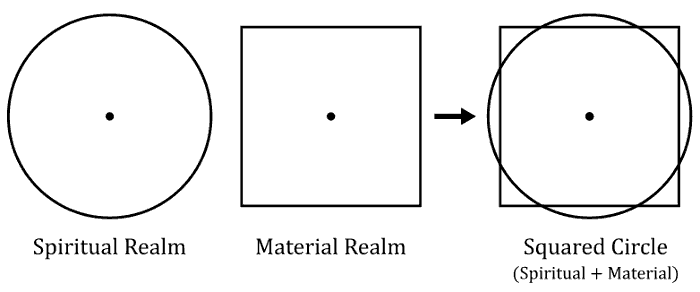
The squared circle features a square and a circle that overlap.
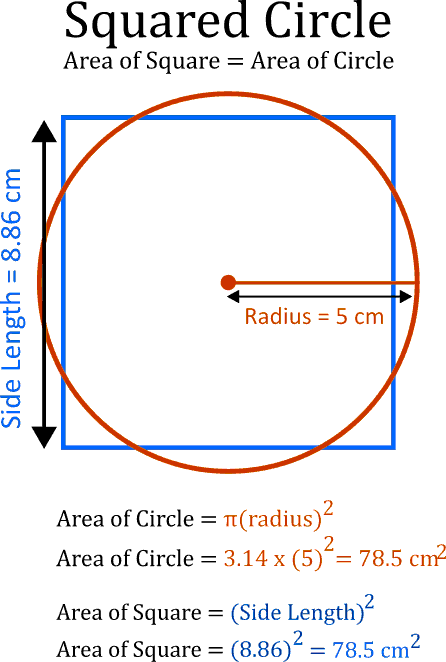
What’s unique about this symbol is that the area of the square and the circle are the same and they share the same center.
The square symbolizes the material realm and the divine masculine energy whereas the circle (which has no beginning or end) represents the spiritual realm and the divine feminine energy. The merging of these two energies is the basis of all existence.
Thus the squared circle is a powerful symbol of creation, unity, duality, oneness, and interconnectedness.
13. Witch’s Knot

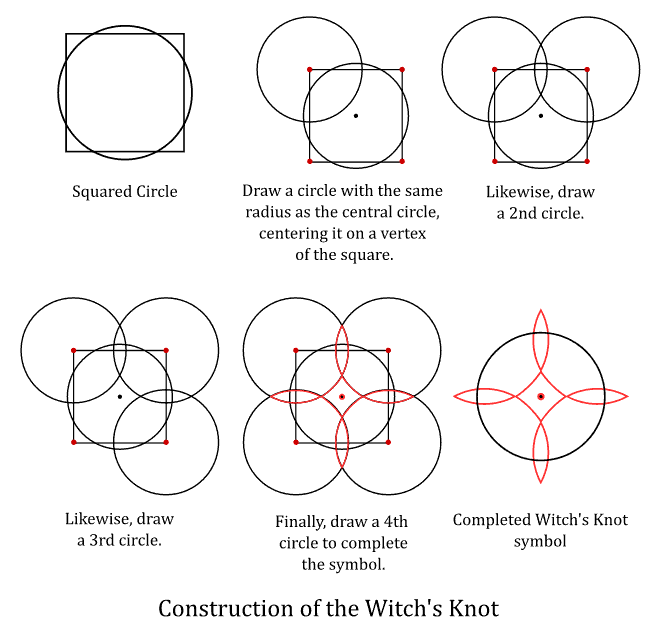
The Witch’s Knot is an ancient symbol that features four interlocking knots centered around a circle. What’s interesting is that this symbol arises out of the Squared Circle that we discussed earlier. The following image illustrates how the Witch’s Knot is created using the Squared Circle.
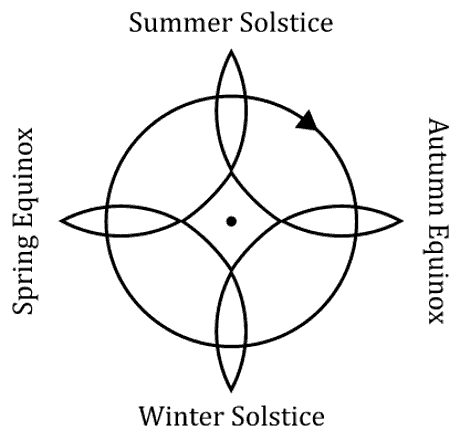
The witch’s knot is a powerful symbol that represents the important quadruplicities of life which include the four elements, the four directions, and the four seasons to name a few. The circle at the center symbolizes the cyclic, interconnected, and everlasting nature of these events. It also symbolizes spirit energy that is present within everything that exists.
Historically, various cultures have used this symbol as an emblem of good fortune and protection.
14. Five Fold knot
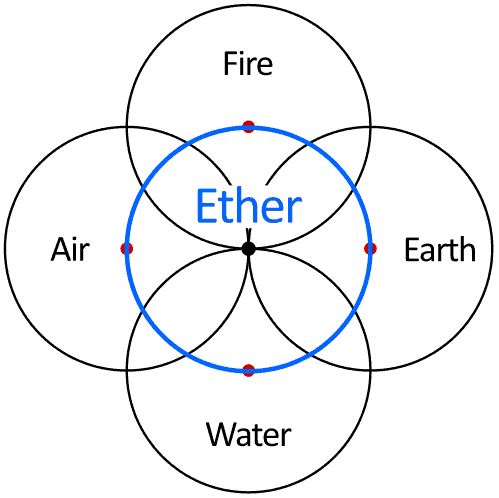
The Five Fold knot is an ancient circular symbol that primarily symbolizes the five elements of nature. It’s composed of five interconnected circles, with four on the outside denoting Fire, Air, Water, and Earth, while the central circle signifies the fifth element of Ether or Spirit.
Interestingly, as shown in the image above, the perimeter of the central circle intersects the centers of the exterior circles, indicating the omnipresence of the spirit within every element. Thus this symbol represents the strong interconnection and interdependence that exists between the four elements. The symbol also represents balance and harmony and the eternal cycle of life.
This symbol is also known as the Five-Fold knot and the Borromean cross.
15. Solar cross
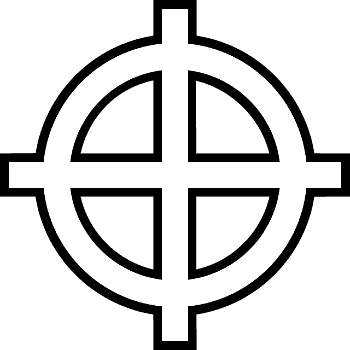
The Solar Cross, also known as the Sun Cross or Wheel Cross, is an ancient symbol that consists of an equilateral cross inside a circle.
It primarily represents the sun with the cross’s arms representing the four phases of the day which are – dawn, noon, dusk, and midnight. The cross’s arms also represent the four important solar events that occur in a given year which include the 2 equinoxes and the 2 solstices. In addition, the cross’s arms can also signify the four cardinal directions – North, South, East, and West and other quadruplicities of life like the four seasons and the four lunar phases.
Also, the vertical line in the cross represents the spiritual world and the divine feminine energy, whereas the horizontal line represents the material world or divine masculine energy. Their point of intersection (which is also the center of the circle) represents the source of all creation. The circle surrounding the cross represents eternity and the cyclic nature of life.
Overall, the solar cross is a powerful circular symbol that represents creation, interconnection, and the eternal and cyclic nature of life.
It’s worth noting that while the Christian cross and the Solar Cross can appear somewhat similar, they have different origins and meanings. The Solar Cross is much older and has been used in many diverse cultures and religions throughout history.
16. Triple Goddess

The Triple Goddess symbol is a prominent pagan symbol that depicts a waxing crescent moon on the left, a full moon in the center, and a waning crescent moon on the right. The symbol primarily represents the three phases of a woman’s life which are are as follows:
- Maiden: Represented by the waxing crescent moon. This phase symbolizes purity, youth, new beginnings, growth, and rejuvenation.
- Mother: Represented by the full moon. This phase signifies maturity, fertility, sexuality, care, and provides sustenance and life.
- Crone: Represented by the waning crescent moon. This phase stands for wisdom, ending, death, and mystical insight.
The Triple Goddess symbol also corresponds to the three main phases of the lunar cycle: waxing, full, and waning. These phases resonate with the cyclical nature of life and the various stages of existence.
17. Zia Sun Symbol

The Zia Sun symbol is composed of a central circle with groups of four straight rays extending outward in four directions. It is an ancient representation that has been used by the indigenous Zia people of New Mexico.
The circle at the center symbolizes oneness, one God, or source energy that binds everything together. It also symbolizes the sun as the giver of life. The four straight rays from each side of the circle represent the various quadruplicities of life which are as follows:
- The four directions – North, West, East, South
- The four phases of life – Childhood, Youth, Middle Years, Old Age
- The four phases in a day – Sunrise, Noon, Evening, and Night
- The four seasons – Spring, Summer, Autumn, Winter
The four sets of rays can also signify the interconnectedness of the earth, humans, and other living beings, all under the sun. This symbol serves as a reminder of the sacredness of number four, the importance of nature, and the interconnectedness of life’s various cycles.
18. Wiccan Wheel

The Wiccan Wheel is a pagan symbol that is composed of a circle segmented into eight equal parts, using lines that radiate out from the center. It primarily represents the 4 major solar events (2 Equinoxes and 2 Solstices) and the four seasons (Spring, Summer, Autumn, and Winter) that happen in a given year. It also represents the important pagan festivals associated with these events as shown in the image above.
Thus, the Wiccan Wheel signifies the cyclical nature of life, highlighting the interconnectedness of birth, death, and rebirth and the eternal ebb and flow of the seasons and natural energies.
19. Hexafoil
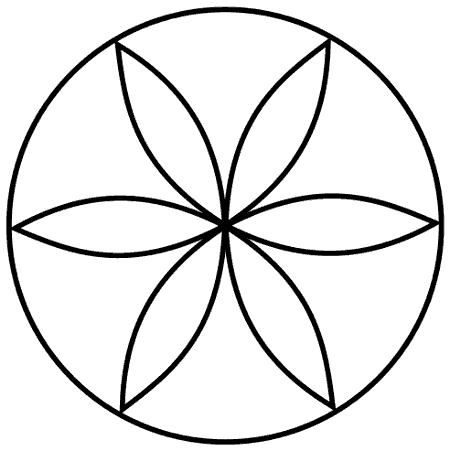
Also known as the ‘Daisy wheel’, a hexafoil is a flower-like symbol created by seven overlapping circles. Throughout history the hexafoil has been used across various cultures as a powerful solar symbol and as a symbol of protection. When expanded so that there are 19 interlocking hexafoils you get the pattern of the ‘Flower of Life’ which is the symbol we will be discussing next.
20. Tree of Life

The Tree of Life is an ancient symbol found in many cultures around the world. It is often depicted either in the shape of a circle or with a circle surrounding it.
The circle around the tree represents the interconnectedness of the tree’s three parts. The roots represent the inner world, symbolizing your inner self. The trunk represents the body, acting as the bridge between the inner and outer worlds. The branches and leaves represent the mind and higher consciousness, reaching outward and upward.
These three parts are not separate but deeply connected, as symbolized by the circle. The tree is only as strong as its roots, showing that the inner world influences the outer world, and the outer world also affects the inner.
In this way, the Tree of Life reflects the timeless principle: as above, so below, as within, so without.
21. Hecate’s Circle
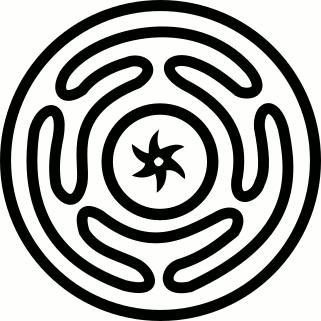
Hecate’s wheel is a powerful circular symbol that is associated with the Greek goddess Hecate – the goddess of magic, witchcraft, moon, and the night.
Resembling a circular labyrinth, this symbol features a central spiral with three symmetrical loops radiating outwards. The three loops symbolize the three realms of existence – the heaven, earth and the underworld, and the interconnection between them.
The wheel is also said to represent the concept of triple goddess – which denotes the three phases of the feminine life cycle – Maiden, Mother, and Crone.
In addition the wheel, is used to represent the various cycles of existence that happen in sets of three, some of which are as follows:
- The three phases of existence – creation, preservation and destruction
- The three phases of the moon – full moon, half moon, and no moon
- Three phases of life – life, death, and rebirth
- Three epochs of time – past, present, and future
- And so on..
Thus the Hecate’s wheel is a potent symbol that represents eternity, feminine energy, interconnection, and the cyclic nature of existence.
22. Shree Chakra (or Shree Yantra)

In Hinduism, yantras are sacred geometric diagrams used in Hindu spiritual practices to focus the mind, channel divine energy, and support meditation or worship. They are often designed within a circular form,
One of the most popular yantras is the Sree Yantra. It consists of a total of nine triangles with four facing upward that represent the divine masculine and five facing downward that represent the divine feminine. The center of the Shree Yantra created by the merging of these triangles is the source of all creation. It is said that focusing on this point during meditation can help one gain powerful spiritual insights.
23. Kongo Cosmogram
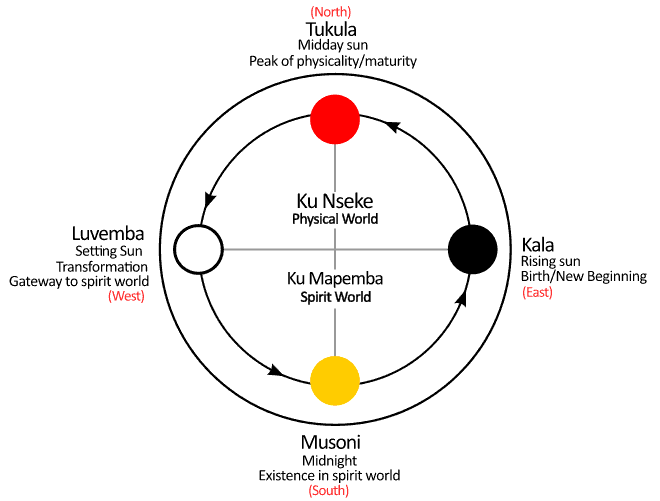 Cosmograms are symbolic diagrams that represent the structure of the universe. Many ancient cultures used cosmograms to express their understanding of the cosmos, and they are often circular in shape. One well-known example is the Kongo Cosmogram.
The Kongo cosmogram explains the nature of reality based on the movement of the sun. This circular cosmogram is divided into 4 segments each representing a phase of life/existence. These include – birth, maturity, old age/death, and rebirth.
The cosmogram also depicts the connection that exists between the spirit and material world and how one can access ancestral wisdom by getting in touch with the spiritual world.
24. African American Medicine Wheel
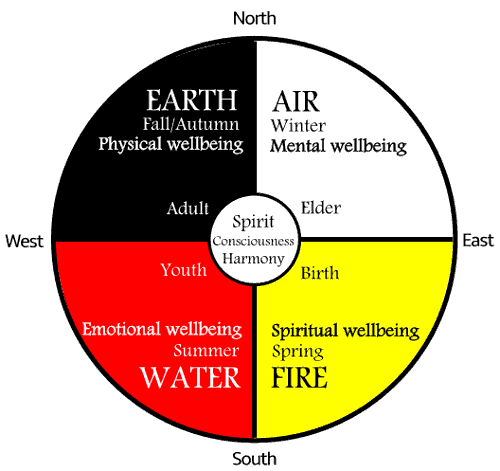
Another popular cosmogram is the African American Medicine Wheel also known as the – Sacred Hoop.
This circular symbol is divided into four quadrants each representing a phase of life/existence. These include the four directions (East, West, North, South), the four elements (Fire, Earth, Air, Water), the four seasons (Spring, Summer, Fall, Winter), the four elements of wellbeing (physical, mental, spiritual, emotional), the four stages of life (birth, youth, adult, death) and the four times of the day (Morning, Noon, Evening, Night).
25. Chakras

Chakras (literally meaning “wheels” or “circles”) are energy centers in the human body according to yogic philosophy. They are visualized as spinning circles of energy, and each chakra is represented by a circular symbol.
Each of the seven chakras is associated with a specific part of the body. Together, these spinning energy centers are believed to support balance, growth, and the realization of our highest potential in life.
26. Mandalas

Similar to the Japanese symbol Enso, Mandala in Sanskrit literally translates to “circle”. These intricately-drawn designs actually carry a similar significance to the Japanese Enso; they symbolize the Universe, oneness, and the individual spiritual path. In fact, the act of creating or focusing on a mandala is known to center one’s energy and promote mindfulness and peace.
27. Fu Lu Shou
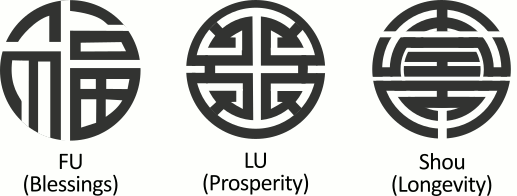
Fu, Lu, and Shou originate from Chinese mythology; they are deities known as the “three stars”, and they represent happiness/blessings, status/prosperity, and longevity. We can see the circle symbolism yet again in the traditional characters for Fu Lu Shou; they are sometimes seen artistically represented with circular characters, exemplifying once again the universal human recognition of the circle’s spiritual nature.
28. Dharma chakra
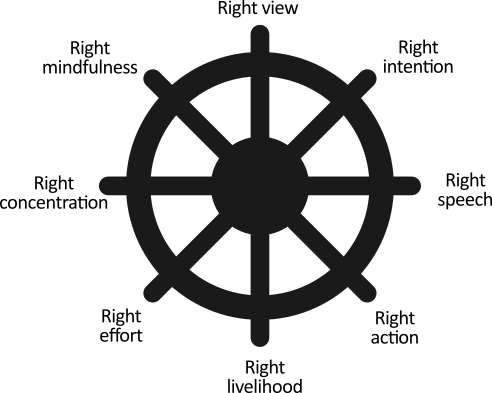
The Dharma Chakra, is a significant symbol in Buddhism, that is composed of a wheel with 8 or sometimes 24 spokes. The wheel primarily represents the Noble Eightfold Path laid out by the Buddha as the means to achieve enlightenment. These are Right View, Right Intention, Right Speech, Right Action, Right Livelihood, Right Effort, Right Mindfulness, and Right Concentration.
It is also used to represent time, the cyclic nature of life, enlightenment, universal laws of existence, and the order and harmony of the universe.
29. Satkona or Star of David
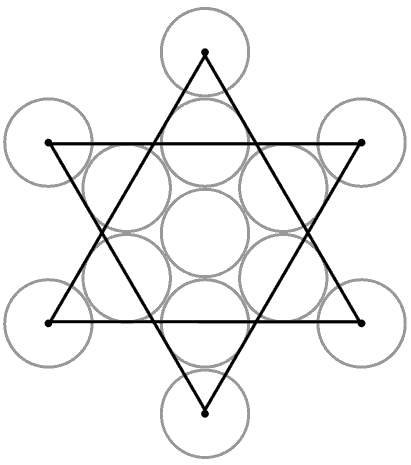
The Satkona (meaning six cornered in Sanskrit) is a sacred Hindu symbol that depicts two intersecting equilateral triangles, one facing upward and one facing downward. The upward-facing triangle represents the divine masculine (material) whereas the downward-facing triangle represents the divine feminine (spirit). Their intersection is the basis of all creation. The Satkona even though it looks like a triangular symbol is, in reality, a circular symbol as it has been derived from the Fruit of Life as shown in the image above.
30. Labyrinth
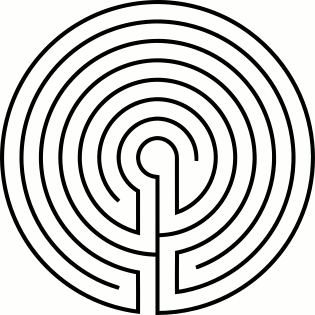
Unlike a simple maze, a labyrinth can only be solved in one way. When you think of mazes, you may picture many dead ends and winding paths; the same is not true within a labyrinth. The labyrinth only contains one winding road, which twists and turns but eventually leads you to an exit without any dead ends. This contains powerful symbolism for the soul’s spiritual journey. These ancient “mazes” are traditionally drawn with winding lines contained inside a circle.
31. Adinkrahene
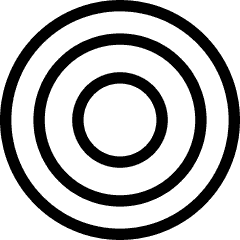
The Adinkrahene is an Adinkra symbol found in western Africa. Literally translated as “Adinkra King,” it is the most important symbol of the Ashanti culture. It is said that the Adinkrahene was the first symbol and served as inspiration for creating all the other Adinkra symbols. It consists of three concentric circles nesting inside each other and represents strength, courage, charisma, and leadership.
As the legend goes, the Adinkrahene was styled after ripples in a pool of water. These ripples may begin small, but they move and manipulate the surface in all directions. The ripples are like a great leader who can create meaningful change without wanton destruction. As the king of the symbols, the Adinkrahene is where all great ideas originate. It is the symbol of those who rule with knowledge, wisdom, and moral integrity.
32. Philosopher’s Stone
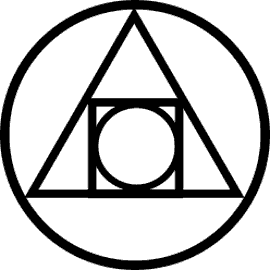
The Philosopher’s Stone is an important symbol in alchemy, depicted using a circular design. It consists of an inner circle representing the inner self or microcosm, and an outer circle representing outer reality or the macrocosm.
The symbol reflects the idea that true transformation comes from bringing harmony between the inner and outer worlds.
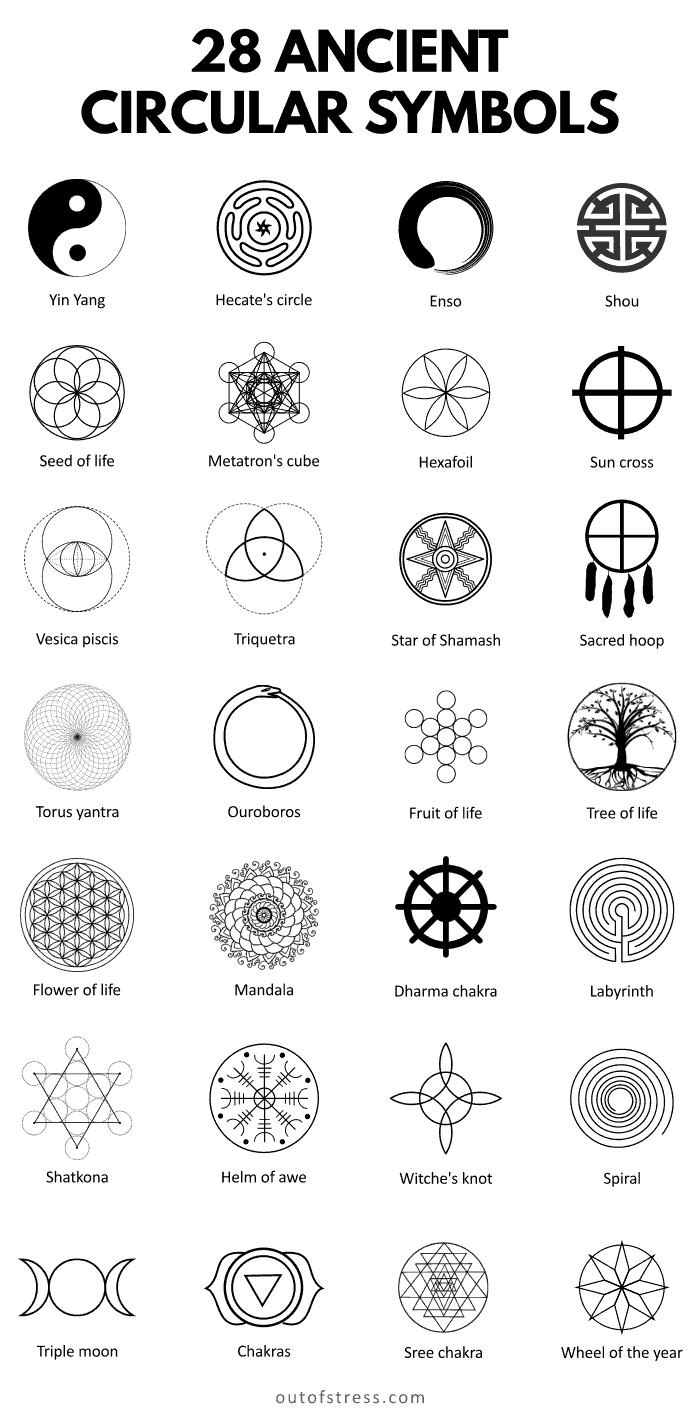
Across cultures and traditions, circular symbols have long been used to represent unity, balance, and the cyclical nature of life. Their universal presence reminds us that everything in existence is interconnected and part of a greater whole.
